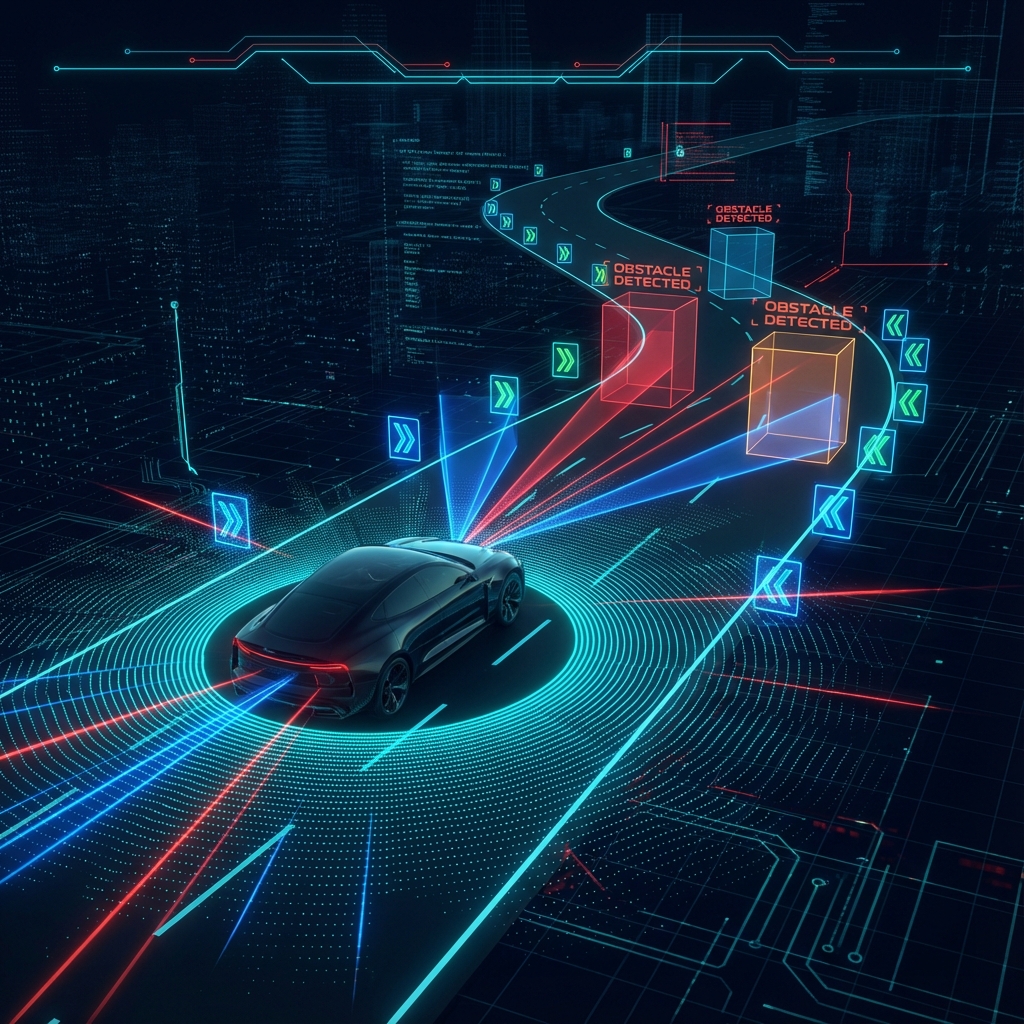
Autonomous Driving & AMR Simulation
Simulation platform for autonomous vehicles and AMRs using CARLA and Gazebo. Custom urban maps model intersections for traffic optimization studies. Validates vSLAM algorithms with synthetic camera feeds and ground-truth poses. LiDAR simulation includes beam patterns and atmospheric effects. ROS integration enables identical stacks in sim and reality.
⚡ Challenges
- •Realistic traffic AI behavior
- •vSLAM ground truth generation
- •Simulation-to-reality transfer
✓ Outcomes
- ✓Cross-road optimization study published
- ✓vSLAM validated pre-deployment
- ✓99.9% collision-free in real deployment
📖 Full Details
This autonomous systems simulation platform provides comprehensive virtual testing environments for self-driving vehicles and Autonomous Mobile Robots (AMRs). Built on CARLA (automotive focus) and Gazebo (ROS integration), the platform enables algorithm development and validation without expensive physical testing.
The CARLA-based automotive pipeline recreates realistic urban driving scenarios. Custom-built maps model specific intersections under study, with accurate lane geometry, signal timing, and pedestrian crossing patterns. Traffic participant AI provides realistic behavior for surrounding vehicles, enabling testing of autonomous systems in complex multi-agent scenarios.
A cross-road traffic optimization study used this platform to evaluate intersection management strategies. By simulating vehicle-to-infrastructure communication, the study demonstrated potential throughput improvements from coordinated autonomous vehicle movements compared to traditional signal control.
vSLAM (Visual Simultaneous Localization and Mapping) implementations were validated in controlled simulation before deployment on physical robots. Synthetic camera feeds with ground-truth poses enabled quantitative accuracy measurements impossible in real environments.
LiDAR-based perception pipelines use simulated point clouds that accurately model sensor characteristics including beam patterns, intensity returns, and atmospheric effects. Perception algorithms trained on synthetic data transferred successfully to real sensor data.
The Gazebo-based warehouse AMR environment tests navigation in dynamic facility layouts. Simulated pallets, people, and other AMRs create realistic obstacle scenarios. Fleet management algorithms coordinate multiple robots, handling traffic, task allocation, and charging scheduling.
ROS integration enables identical software stacks to run in simulation and on physical robots, ensuring reliable simulation-to-reality transfer. The platform has validated navigation algorithms achieving 99.9% collision-free operation in real deployments.